
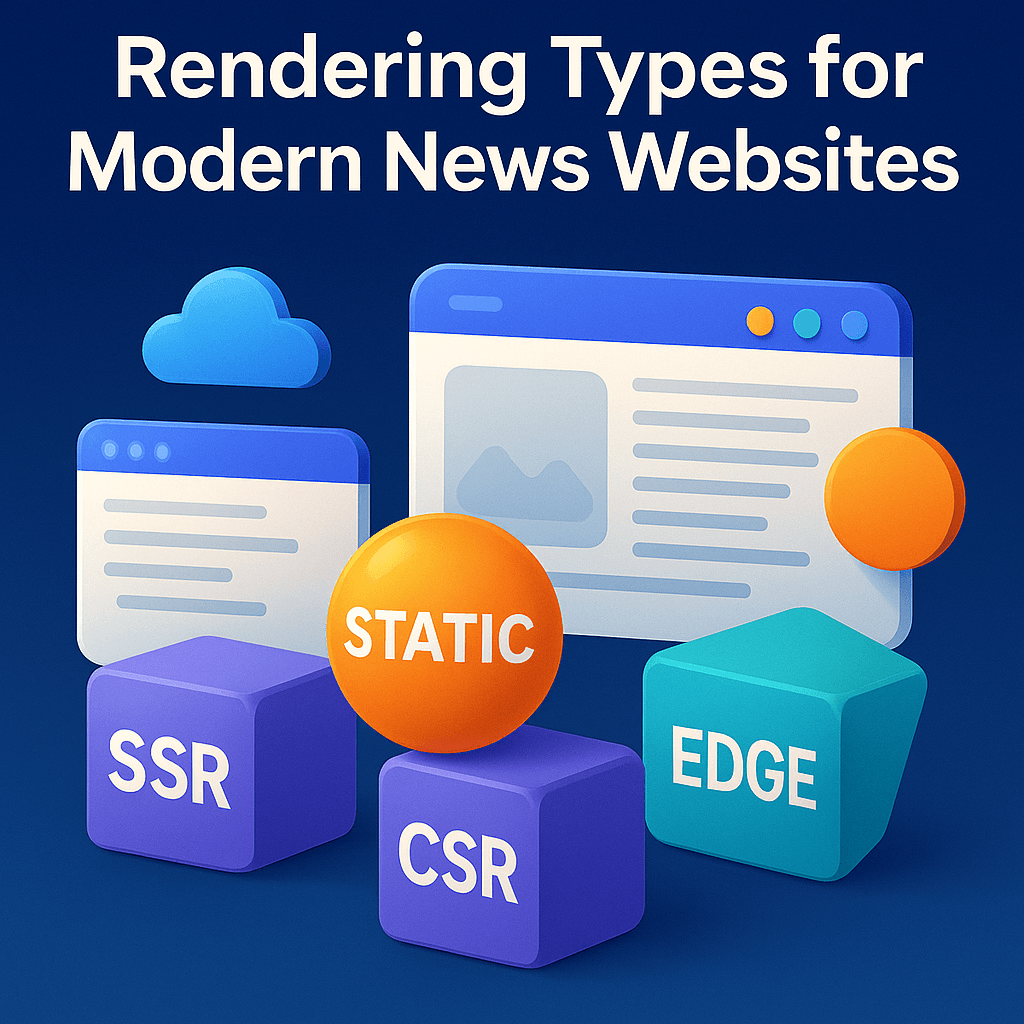
The Battle for Milliseconds: How Rendering Affects Core Web Vitals and Visibility in AI Search
In 2026, the performance of a media resource is determined by its rendering architecture—the choice between Server-Side Rendering (SSR), Edge Rendering, and Static Site Generation (SSG). These technologies directly affect the key Core Web Vitals user experience metrics, including LCP (rendering speed) and INP (interface responsiveness), which have become critical ranking factors in both traditional search engines and AI answer algorithms. Properly configured content delivery through a CDN and optimization of computation at the “edge” of the network allow publishers to minimize latency, reduce bounce rate, and ensure that content is correctly indexed by AI agents (LLM crawlers). Understanding these processes enables media management to make informed infrastructure decisions that directly affect advertising revenue and subscription conversion.
What Rendering Is
Before diving into abbreviations like SSR or Edge, let’s first understand the process itself. When a reader clicks a link to your article, they do not instantly receive a finished picture. Their browser, whether on a smartphone or a computer, requests a set of data that must be transformed into a visual product.
Rendering is the process of “assembling” a web page from disparate elements: program code, text from a database, styling, and heavy media files.
A simple metaphor: a website as modular furniture
To better understand how this works, imagine that you ordered a wardrobe from an online store. Rendering is the process of receiving and assembling it.
The classic option: a craftsman assembles the wardrobe at the factory and delivers it to you already finished. All you need to do is put it in the room. This is fast for you, but it requires resources from the factory.
The “IKEA” option: you are delivered boxes with parts and an instruction manual. You spend your own time and effort assembling it right in your apartment. This saves the store’s resources, but makes you wait and do the work yourself.
The “local warehouse” option: the finished wardrobe is already assembled and waiting in a warehouse in your district. It is delivered almost instantly the moment you click “buy.”
In the media world, choosing one of these paths directly affects how quickly the reader sees the content and how “heavy” this process turns out to be for both your server and the user’s smartphone.
Five ways to deliver content: a brief overview
In modern web development, there are five key approaches. Each has its own role, its own advantages, and its hidden costs.
SSG (Static Site Generation) — Prebuilding. Pages are created once, for example at the time of publication, and stored as ready-made files. The essence is maximum speed: the reader receives the content instantly. The downside is that it is not suitable for a news feed that changes every minute.
ISR (Incremental Static Regeneration) — Smart updating. This is advanced static rendering. The page is built in advance, but the system is able to “silently” update it in the background when data changes. The essence is the ideal balance of speed and freshness for most media outlets.
SSR (Server-Side Rendering) — Assembly on the server. The page is assembled on your server at the moment the user clicks. The essence is that the content is always 100% fresh, but under a surge of traffic the server may “choke.”
Edge Rendering — Assembly at the “edge” of the network. This is the evolution of 2026. The page is assembled on the global network server closest to the reader, that is, on the CDN. The essence is the speed of static delivery combined with the flexibility of a full-fledged server. It is the best choice for global reach.
CSR (Client-Side Rendering) — Assembly on the reader’s side. The user’s browser receives the “instructions” and builds the page itself. The essence is that it makes it possible to create complex tests, calculators, and interactive maps. The downside is a heavy start: on older smartphones, the reader may stare at a blank screen for a long time.
| Rendering type | Loading speed (LCP) | Content freshness | Load on your server | Ideal for... |
|---|---|---|---|---|
| SSG | Extreme | Low | Almost none | Special projects, archives |
| ISR | High | Medium | Low | News, articles |
| SSR | Medium | Real-time | High | Personal accounts, search |
| Edge | High | Real-time | Distributed | Global news |
| CSR | Slow | Real-time | Low | Interactive features, games |
Section 3. What the rendering type affects: People, Robots, and Algorithms
In 2026, the choice of rendering technology is direct control over the efficiency of your media business. The way your website “assembles” pages determines how high you rank in search and whether a reader will want to come back tomorrow.
1. The live user: comfort and wallet
We often forget that a website does not open in a vacuum, but on a real device in a person’s hands.
Saving battery life and resources. When CSR is used, the main work is performed by the smartphone’s processor. This causes the phone to heat up and the battery to drain faster. SSR and Edge, by contrast, deliver “finished” content, saving the device’s energy. In 2026, this is an act of care for the reader, especially in regions where inexpensive smartphones are common.
Accessibility on a poor connection. Under 3G conditions or unstable Wi-Fi, SSG, ISR, and Edge perform best. They send the text first of all—the HTML—allowing a person to begin reading the article while heavy images are still loading. With CSR, the user often sees an empty screen until the entire “skeleton” of the site has loaded.
The psychology of waiting. Research shows that the gradual appearance of content—headline, then text, then photo—typical of SSR and Edge, is perceived as “fast.” Waiting in front of a blank screen with a spinner, which is typical of CSR, increases stress and makes users close the tab after just 2–3 seconds.
2. Core Web Vitals: the mathematics of success
Google uses these metrics as a “thermometer” of your site’s health. Rendering is the main lever that lets you push these indicators to the maximum.
LCP (rendering speed). Edge and ISR lead here. The main content appears almost instantly because it is physically located close to the user.
INP (responsiveness). This is the key metric of 2026. It measures how quickly a site reacts to a click or a scroll. Heavy JavaScript in CSR clogs the main thread, which makes the site feel sluggish and unresponsive. SSR and Edge make the interface light and responsive.
CLS (stability). Server-side rendering makes it possible to reserve space for ad blocks in advance, eliminating the annoying jumps in text during loading.
3. Search and AI: how algorithms see you
In 2026, your content is consumed by two kinds of robots: classic search engines and AI agents.
Google Search & Discovery. Crawlers prefer “clean” HTML. If your text is buried deep inside scripts, as with CSR, indexing may take days instead of minutes. For a news outlet, that is unacceptable. SSR and ISR guarantee immediate entry into the index.
LLM Bots (Perplexity, SearchGPT, Gemini). AI agents scan the site in order to compose a short answer for the user. What matters to them is machine readability and freshness. Edge Rendering gives them the freshest possible version of the data, which increases the chances of your brand becoming the primary cited source in neural-network answers.
Summary impact matrix
| Impact factor | SSG / ISR | SSR / Edge | CSR (Client-side) |
|---|---|---|---|
| Smartphone battery usage | Minimal | Low | High |
| Performance on a poor connection | ⭐⭐⭐⭐⭐ | ⭐⭐⭐⭐ | ⭐ |
| Indexing speed (SEO) | Instant | Fast | Delayed |
| Comprehension by AI bots (LLM) | Excellent | Excellent | Difficult |
Section 4. SSG + Caching: the strategy of maximum resilience
In 2026, for most content projects the optimal choice is architecture based on SSG, or Static Site Generation. In this model, pages are generated in advance and turned into ready-made files that are instantly delivered to the user from cache. This eliminates unnecessary database requests on every visit and guarantees stable operation under any load.
Implementing the static approach in media
1. Prebuilding pages (Build-time SSG). All key sections of the site, from the homepage to archive news pages, are prepared in advance. The process works as follows: when a piece is published or during a scheduled project build, the server creates final HTML files. These ready-made files are placed on a CDN, a content delivery network. The user receives content from the server closest to them, which reduces waiting time almost to zero. The effect is ideal LCP scores and no load on the site’s main database.
2. Instant updating mechanism (On-demand Revalidation). For a news resource, it is critically important that edits appear immediately. Modern SSG allows selective cache updates. As soon as an editor clicks “Publish” or “Save,” the CMS sends a signal to the system by webhook, and only that specific page is rebuilt in fractions of a second. The effect is that both readers and AI agents see the changes immediately, even though the site remains static.
3. Hybrid inclusions for dynamic elements (Client-side Hydration). If a static page needs dynamic elements, such as the number of views, a subscription form, or poll results, they are layered on top of the static content. The main text of the article loads as a static file, while small dynamic blocks are loaded by the browser via API. The effect is that the site remains fast and reliable while preserving the necessary interactivity.
Matrix: Static content and cache
| Content type | Method | Caching strategy | Advantage |
|---|---|---|---|
| Articles and news | SSG | Edge Cache (Global) | Instant access from anywhere |
| Homepage and sections | SSG | On-demand Revalidation | Updates only when changes occur |
| Media files (photos) | Static | Permanent Cache | Traffic savings and high speed |
| Personal data | API | No cache / Local Storage | Accuracy and privacy |
Checklist for evaluating an SSG architecture
When moving to a static model, it is important to make sure the following processes are ready:
Build Time. How quickly the system can build 10,000+ pages. Modern tools should do this incrementally, updating only the files that have changed.
CDN integration. Whether automatic cache purging is configured across all nodes of the network immediately after edits are made.
Fault tolerance. What the user sees if the main database is temporarily unavailable. A properly configured SSG setup will allow the site to continue operating normally.
Conclusion
The combination of SSG and caching minimizes the number of links between content creation and content consumption. In 2026, this solution allows a media resource to ensure the highest loading speed and predictable infrastructure costs, regardless of traffic volume and the complexity of search algorithms.
FAQ: Briefly about the essentials
1. If we choose SSG, how quickly will readers see breaking news after the “Publish” button is clicked? With the modern On-demand Revalidation feature, rebuilding a specific page takes fractions of a second. As soon as the editor saves the material in the CMS, the system sends a signal to clear the cache, and the next visitor is served the updated static copy.
2. Does the rendering type affect hosting costs? Yes, substantially. SSG is the most economical option, because the main load falls on content delivery networks rather than on your servers. SSR, by contrast, requires constant capacity to generate pages for every visit, which means that as traffic grows, infrastructure costs rise proportionally.
3. Is it true that Google has long been able to index JavaScript, so there is no need to worry about rendering? Google can indeed execute JavaScript, but it does so in “two waves.” First, it indexes what it sees immediately, the HTML, and script execution may be postponed from several hours to several days. For a news outlet, that delay is critical. SSG and SSR guarantee that all content is indexed immediately.
4. Why do AI bots such as SearchGPT and Perplexity need fast rendering? AI agents work like ultra-fast browsers. It is important for them to get “clean” text without having to wait for complex scripts to run. The easier it is for the bot to read the structure of your page and its up-to-date content, the greater the chance that your material will become the primary source for a neural-network answer.
5. What are Core Web Vitals, and why is this a concern for managers rather than only for IT? Core Web Vitals are a set of metrics—rendering speed, responsiveness, and layout stability—that Google uses for ranking. Poor scores directly reduce search positions and increase the cost of acquiring traffic. The rendering type is the foundation on which these metrics are built.
6. Is it possible to combine different rendering types on one site? Yes, and in 2026 this is the recommended approach. For example, archive articles can be static through SSG, the homepage can update in the background through ISR, and a subscriber’s personal account can work dynamically through SSR or CSR.