This guide helps tech leads, product managers, and publishers navigate architectural decisions that define how a newsroom operates in 2026. In an industry where publishing speed is directly tied to revenue, choosing between a monolithic platform, a Headless approach, or a hybrid (Composable) model is no longer purely a technical question. Today, it is a strategic calculation that combines three critical factors: total cost of ownership (TCO), editorial interface efficiency, and technical performance (Core Web Vitals). We will analyze how each model adapts to the realities of the modern publishing business and how next-generation platforms such as Fourth Estate enable a shift from maintaining legacy infrastructure to actively developing the product.
Technical essence: how these systems are structured
To make an informed choice, you need to understand how the three main components of any media platform are connected: the admin panel (where editors write), the backend (where logic and the database are stored), and the frontend (what the reader sees).
1. Monolithic architecture
In a monolith, the frontend, admin panel, and backend operate as a single inseparable application. All parts of the system are tightly coupled and use shared technologies.
Strength: This solution is максимально simple to deploy and maintain at the start. You do not need to configure connections between different servers — everything works “out of the box.”
Challenge: A monolith is inconvenient to scale. If you want to change the site design or add a complex feature, you have to touch the entire application. Any change in one part can unpredictably affect others.
2. Headless CMS
This is a system that has literally had its “head cut off” — that is, the frontend part (the visual side of the site). This architecture consists only of the backend and the admin panel.
Strength: The main advantage is complete freedom. Through APIs, you can connect any frontend to a single admin panel: a website, a mobile application, or even a smart speaker. At the same time, you are not limited in technology choice — your website can be written in React, and the mobile app in Swift, and they will seamlessly receive the same content.
Challenge: You will have to create and maintain frontend applications from scratch yourself. Without a development team, you will not get a ready-made website — only an interface for entering text.
3. Hybrid (Composable) architecture
The hybrid (the model on which the Fourth Estate platform is built) combines both approaches, offering flexibility without unnecessary complexity.
How it works: Here, the frontend is already connected “out of the box,” so you can launch a full-fledged website immediately after installation. At the same time, the system retains a Headless architecture: you still have the ability to connect any other applications, mobile services, or mailing systems via API.
Strength: You get a ready-made visual tool for the editorial team, while not losing the ability to scale and develop your own digital products in parallel with the main website.
Characteristics
| Characteristic | Monolith | Headless | Hybrid |
|---|---|---|---|
| System composition | Admin + Backend + Frontend | Admin + Backend | Admin + Backend + Frontend |
| Ready-made site immediately? | Yes | No (needs coding) | Yes |
| Freedom of API client choice | Limited | Full | Full |
| Maintenance complexity | Low (initially) | High | Medium |
How architecture affects SEO and user experience
In 2026, search engines and AI agents (such as SearchGPT or Perplexity) evaluate a site not only by the quality of its text, but also by its “technical health.” Your choice of architecture directly determines how quickly and correctly your content is delivered to the reader.
1. Loading speed and Core Web Vitals (LCP, INP, CLS)
Google uses Core Web Vitals metrics as one of the main ranking factors. If a site is “heavy,” it loses positions.
Monolith (especially the “Bloated WordPress” case): This is the most common problem in media. To add features (ads, galleries, subscriptions), publishers install dozens of plugins. Each plugin adds its own scripts, which conflict with each other and overload the browser.
Result: The INP (click responsiveness) metric drops, and LCP (content rendering speed) increases due to “dirty” code. The site becomes sluggish, and Google lowers it in rankings.
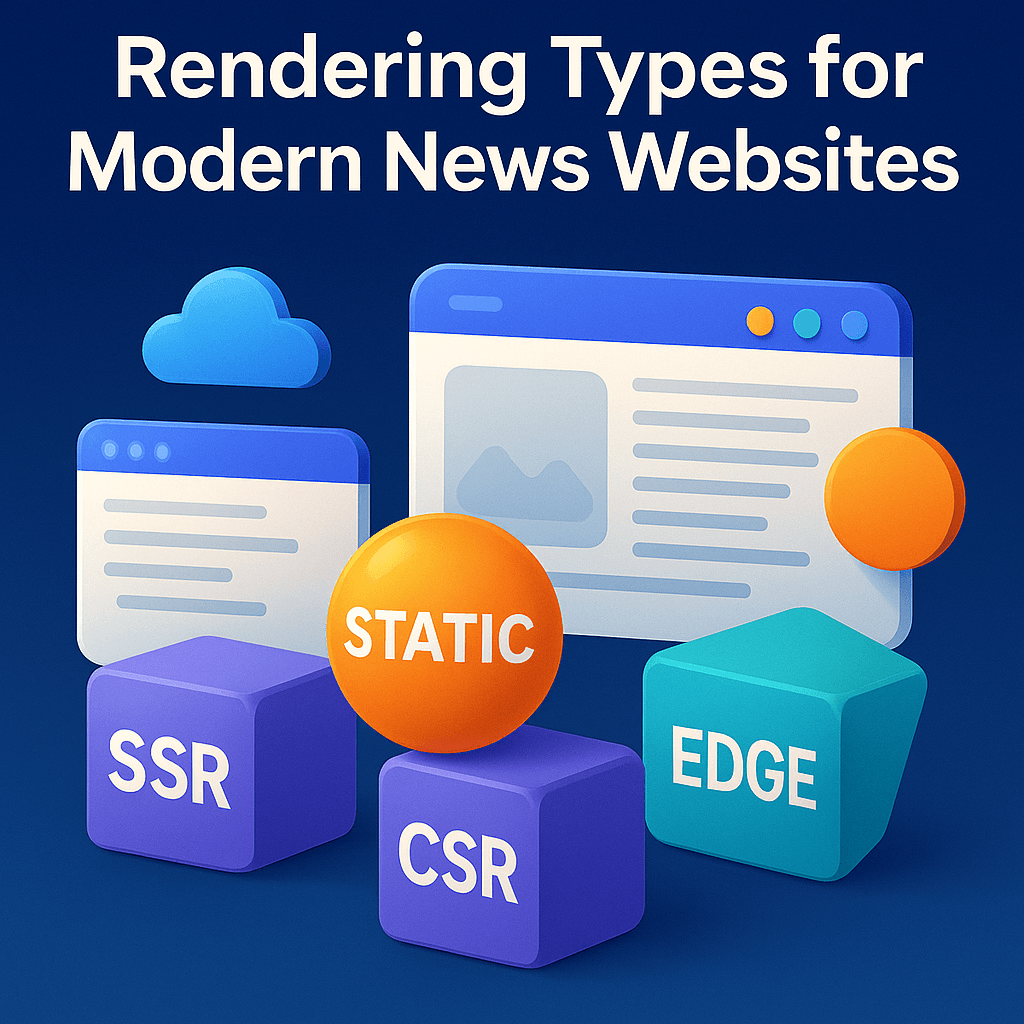
Headless: Provides maximum potential for speed. Since the frontend is a separate application, developers use modern methods (for example, SSG — static generation). Pages open instantly because the browser receives clean HTML without extra plugin “noise.” This is the ideal path to the “green zone” in Google Lighthouse.
Hybrid: Combines advantages. You get an optimized frontend “out of the box,” where all core media functions are already built into the core and configured according to search engine requirements. You do not need to install 20 plugins for the site to work — everything is already balanced and does not interfere with each other.
2. Search visibility (SEO) and indexing by AI bots
For media, it is critical that a news story appears in search seconds after publication.
Monolith: Usually has predictable indexing, but due to plugin overload, it becomes increasingly difficult for search bots to separate useful content from technical “noise.” For AI agents, such a site looks like a cluttered attic where it is hard to quickly find facts.
Headless: This is a zone of high control. You decide how to deliver data to bots. With proper configuration (Server-Side Rendering), your content becomes a “favorite” of search engines due to structural clarity. However, an API configuration error can make the site invisible in search.
Hybrid: The safest and most efficient option. The system (for example, Fourth Estate) is designed to deliver content in a максимально structured form. This makes it ideal “fuel” for AI answers, where a clear data hierarchy without unnecessary code is important.
3. User experience (UX) and interactivity
Monolith: Often limited by standard templates. Any interactive solution (live chats, instant filters) further slows down the system and makes it inconvenient on mobile devices.
Headless: Allows creating a unique interface that feels like a fast mobile app. Page transitions are instant, without reloading the entire site shell.
Hybrid: Gives the editorial team the ability to improve UX independently through visual builders. Editors can quickly change page structure and add traffic recirculation blocks, directly increasing user time on site.
Metrics
| Metric | Monolith (Bloated WP) | Headless | Hybrid (Fourth Estate) |
|---|---|---|---|
| Speed (LCP) | Low (due to plugins) | Maximum | High (optimized) |
| Responsiveness (INP) | Poor (JS blocking) | Excellent | Stable |
| AI indexing | Difficult (extra code) | Ideal | Ideal |
| SEO breakage risk | High (conflicts) | Medium (needs tech lead) | Minimal |
If your goal is to dominate search and retain a mobile audience, the architecture must allow the site to remain “light.” Monolith often becomes a burden, while Headless and Hybrid open the door to top positions due to technical cleanliness and speed.
Team and ownership: who really controls your CMS?
The choice of architecture determines not only the code, but also your team structure and the daily tasks of your employees.
Monolith: “Hostages of the ecosystem”
Team: You need a PHP developer and a DB administrator. Most of their time goes into “fixing” what broke after another plugin update.
Ownership: You own the system, but it dictates the rules. The editorial team is often limited by standard templates, and any deviation turns into a long development and testing cycle.
Headless: “Your own IT shop”
Team: You need a full engineering team (Frontend, Backend, DevOps). You are now a software company.
Ownership: You have full freedom, but also full responsibility. You own “clean” content, but how it is displayed and how fast the site loads depends entirely on your developers. If the tech lead leaves, system support can become a critical problem.
Hybrid: “Reasonable partnership”
Team: Minimal technical support. Developers focus on unique features (special projects, data), not basic things like authentication or galleries.
Ownership: The editorial team owns a tool that allows them to be autonomous (change layout, manage the homepage), while the IT department owns a stable architecture that is easy to scale via API.
Fourth Estate cloud hybrid: a turnkey solution for ambitious media
At Fourth Estate, we believe media should spend 90% of resources on content and distribution, not on fighting infrastructure. That is why we offer not just code, but a Managed Hybrid Cloud — a ready-made ecosystem with service and support.
What is included in our cloud solution:
- Ready-made frontend with infinite flexibility: You get a site with top Core Web Vitals metrics “out of the box,” while retaining the ability to connect any custom features via our API gateways.
- Infrastructure as a Service (SaaS): You do not need to hire DevOps engineers or monitor servers under load. We handle hosting, security, caching, and attack protection. Your site is always available, even if a million users arrive within an hour.
- Ecosystem of applications via API: Need to launch a mobile app? Connect a new mailing service or AI translation tool? Fourth Estate already has the “rails” (API protocols) that allow your internal or third-party applications to instantly receive structured data.
- Personal support and Custom Development: Unlike standard cloud builders, we understand the specifics of media. If you need a unique feature that is not in the base, our development team will implement it specifically for your project, integrating it into the overall stable system.
Result: why is it beneficial for business?
By choosing the Fourth Estate cloud hybrid, you combine the reliability of a monolith (everything works immediately), the power of Headless (APIs for any applications), and the speed of the cloud (no server concerns). This allows your team to exit the “constant repair” mode and start building a modern media business.
Conclusions: which architecture will win in 2026?
The choice between Monolith, Headless, and Hybrid is not just a technical decision — it defines your media strategy for the next 3–5 years.
- Monolith remains the choice for small editorial teams, where simplicity is more important than scalability, and technical debt (slow loading and poor UX) is not yet critical.
- Headless is a powerful tool for technology giants with large IT budgets, ready to build and maintain their own software platform from scratch.
- Cloud Hybrid (Fourth Estate model) is the “golden mean” for professional publishers. It provides the speed and flexibility of modern API technologies while maintaining the convenience of a ready-made editorial interface and the reliability of a turnkey cloud service.
In an environment where search engines and AI agents prioritize technically advanced and fast websites, moving to a hybrid architecture becomes not a luxury, but a condition for survival and audience growth.
Frequently Asked Questions (FAQ)
1. Is it difficult to migrate an old site to a hybrid platform?
Migration is always a project, but in the hybrid model it is easier. Since we have ready API gateways, data from your old database (WP, Drupal) is imported in a structured way. You are not just “copying” the site, but performing a deep content cleanup for better SEO.
2. If we choose a cloud hybrid, will we become “locked in” by the vendor?
On the contrary. Unlike closed monoliths, the Fourth Estate hybrid architecture is built on open API standards. Your content is always available in a “clean” form via API. You can connect your mobile app or third-party service at any time without asking permission from the platform.
3. Can our internal development team build their own features for Fourth Estate?
Yes. This is one of the main advantages. You can use our frontend for 90% of standard pages, and for unique interactive projects your developers can use our APIs, creating custom solutions in any language they prefer (React, Vue, Next.js).
4. How does the cloud solution handle massive traffic spikes?
We use an elastic cloud with automatic scaling. If your story goes viral and traffic increases 100x in 10 minutes, the system automatically allocates additional resources. You do not need to pay for powerful servers “just in case” — the cloud adapts to real load.
5. Will switching to a new architecture help improve rankings in Google?
Yes, due to improved Core Web Vitals. We guarantee high LCP (rendering speed) and INP (responsiveness) metrics, which is a direct signal for Google to rank your site higher than competitors stuck on slow monoliths.