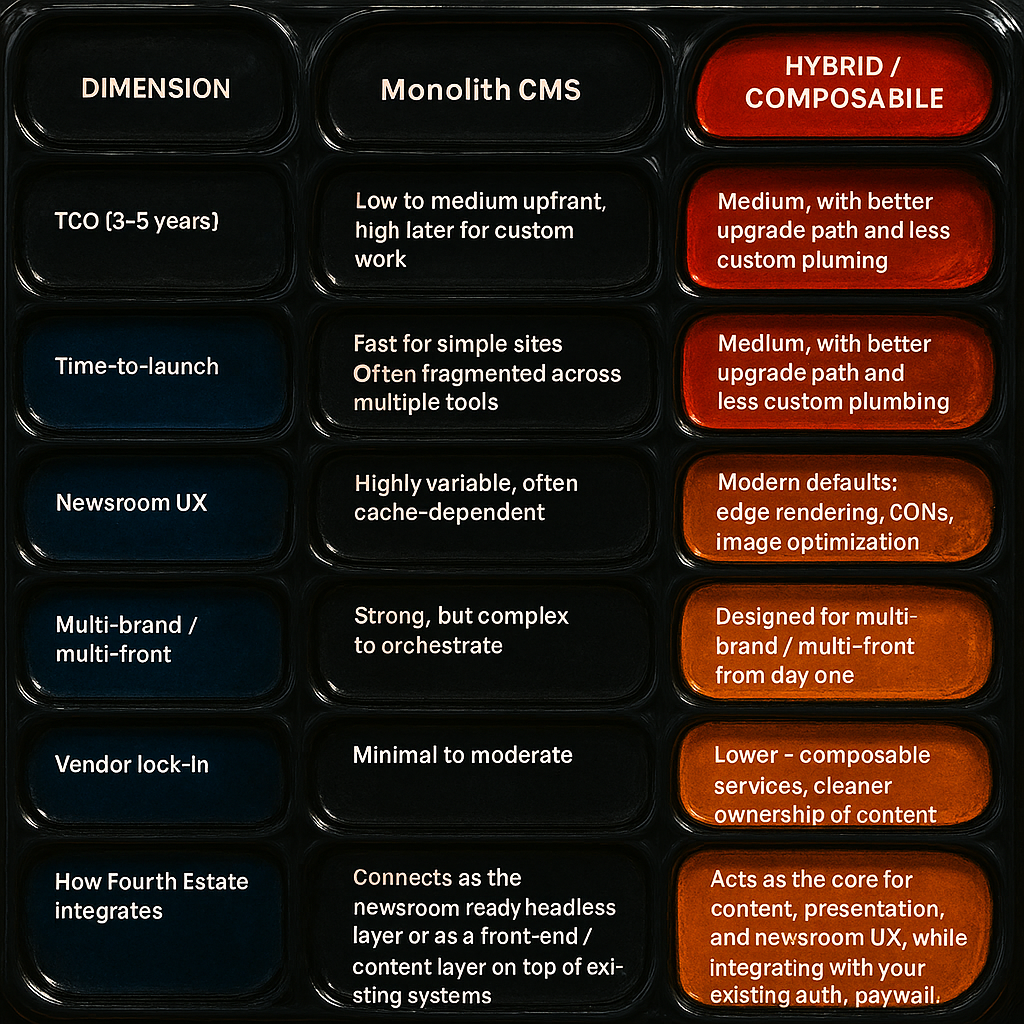

This article is for the people stuck in the middle of that debate – tech leads, product owners, and editors who keep getting dragged into architecture discussions they never asked for. It’s not a sales pitch and it’s not a theology fight about “the one true CMS”. It’s a practical guide to choosing between monolith, headless, and hybrid/composable setups based on three things that actually matter in news: total cost of ownership, newsroom UX, and performance.
By the end, you should have a clearer sense of which model maps to your reality, how a platform like Fourth Estate can sit alongside what you already have, and what a sane migration path might look like – whether you’re planning a full rebuild or just trying to get out of survival mode.
Table of Contents
- Why this article exists
- Monolith vs Headless vs Hybrid – in newsroom language
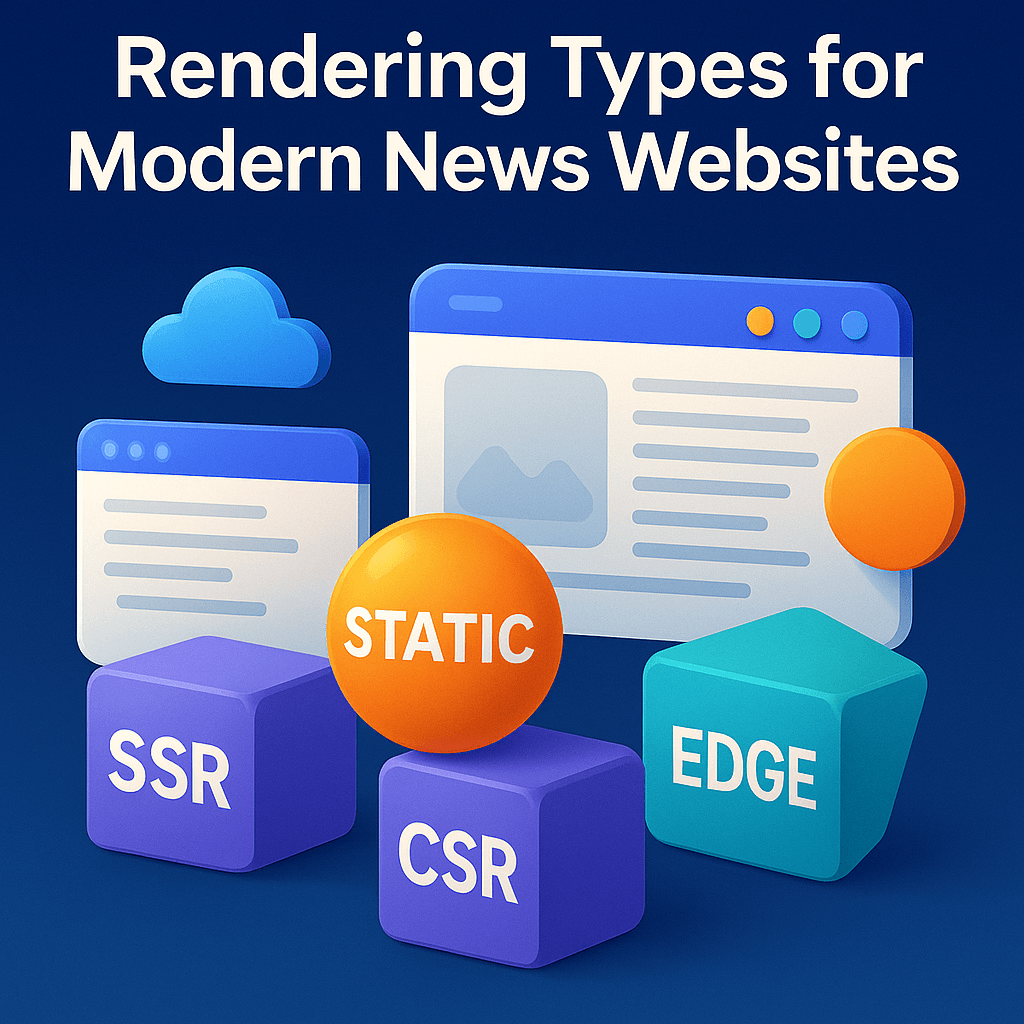
- The three key lenses: Cost, UX, Performance
- How each model stacks up (quick comparison)
- Where Fourth Estate fits in modern stacks
- How to choose what’s right for your newsroom
- Planning the switch: from old stack to new
The three models in newsroom terms
Forget vendor decks for a second. Think about the tools your editors actually touch every day and the tickets your tech team keeps reopening. That’s where the differences between these models really show up.
Monolith
This is the “everything lives in one box” setup.
Editors log into one familiar backend, change a headline, hit publish, and the story is live. The same system controls the article page, the homepage, the paywall, forms, even half the marketing widgets. Classic WordPress installs with a big theme and a pile of plugins usually land here, as do many older “all-in-one” newsroom systems.
Real-life picture:
A regional daily that’s been on the same CMS for 8 years. The editor-in-chief knows exactly which button to press to push out a breaking story at 3am. But every time the team wants a new subscription offer or a special elections layout, the development estimate starts at “well… it’s complicated”.
What feels good: one vendor, one interface, one mental model.
What hurts later: performance tuning, deep customisation and modern integrations (new paywall, first-party data tools, event pipelines) get expensive or fragile very quickly.
Headless
This is the “content here, presentation there” approach.
Editors work in a content hub – the headless CMS – where they write, tag, and organise stories. The website, apps, newsletters and even external partners pull that content via APIs. Other systems like paywall, CRM, search and DAM plug in through webhooks and event streams.
Real-life picture:
A digital-native investigative outlet that wants the same membership content to appear on its site, in a mobile app, and inside a member portal. Their small but strong product team designs a custom front end, wires in a headless CMS, and connects it to their own paywall and analytics stack. It’s fast, flexible – and very much a software project.
What feels good: modern performance, “publish once, use everywhere”, lots of freedom to design your own experience.
What keeps you up at night: you now own all the glue. Without a solid product/engineering team, you’re maintaining a home-built platform, not just “a CMS”.
Hybrid / Composable
This is the “best of both worlds, but with guardrails” option.
You still get a headless core for content, but on top of it you have opinionated, pre-integrated pieces for the things most newsrooms do in a similar way: sections, homepages, paywall hooks, tagging, recirculation blocks, newsletter sign-ups, etc. Around that, you keep open slots to plug in your preferred identity provider, payment system, analytics, recommendation engine and so on.
Real-life picture:
A mid-sized publisher running two brands. They move to a composable platform: editors manage both titles in one place, drag-and-drop their homepages, and launch a new vertical in weeks instead of months. The tech team still codes where it matters – custom components, special projects – but they’re no longer rebuilding the basics for every site.
What works well: most of the flexibility and performance of headless, without having to assemble everything from raw APIs.
What you still manage: you’re curating a stack and making choices – but from a smaller, saner menu, instead of an empty supermarket aisle.