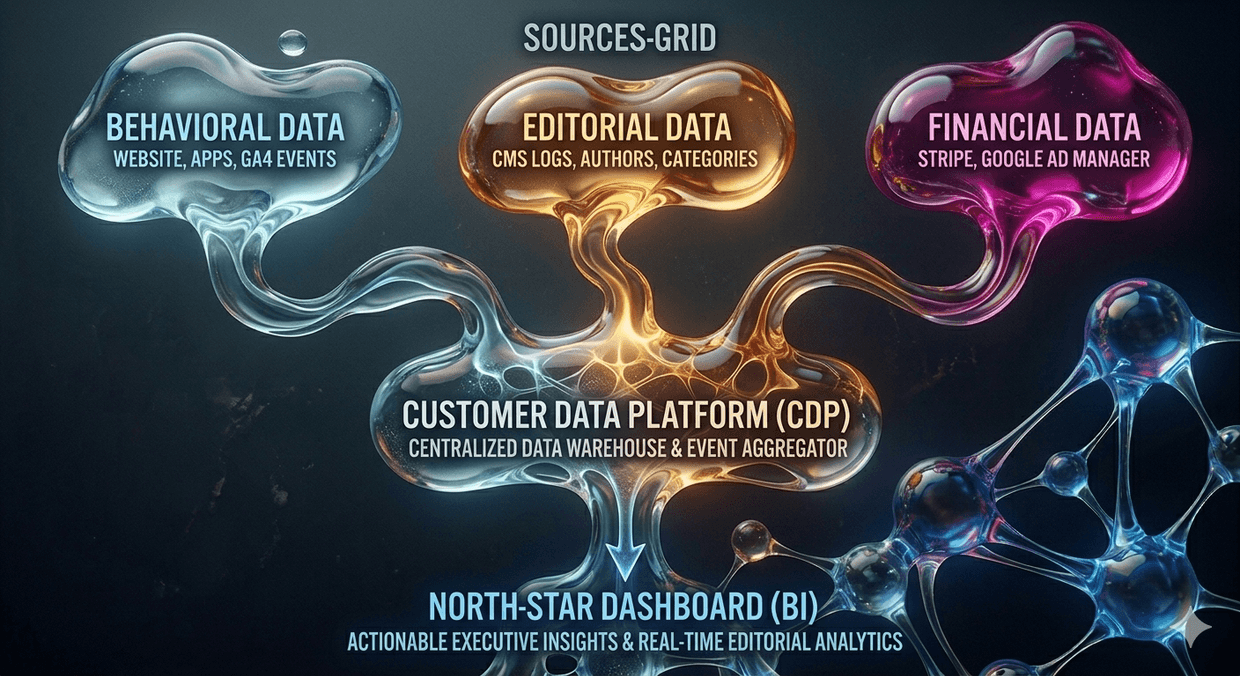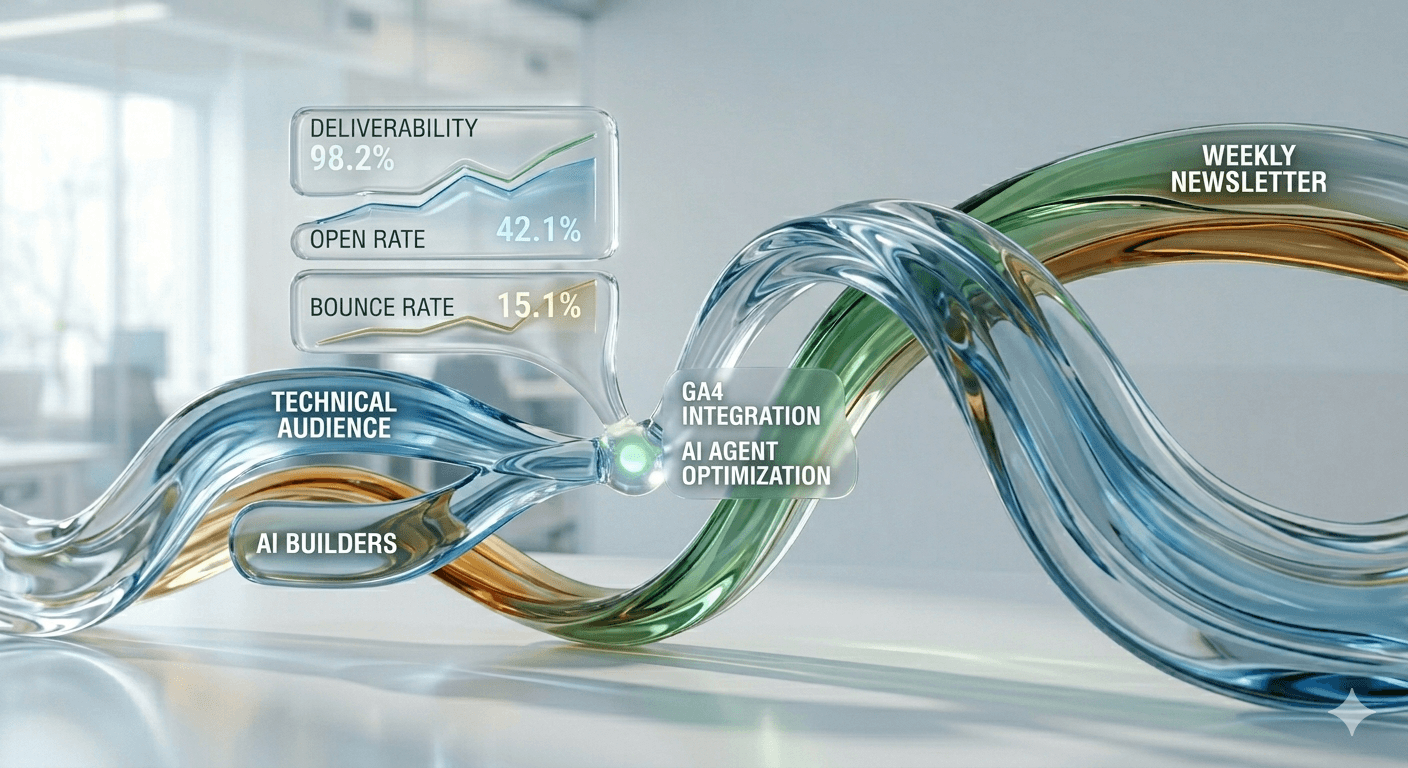

How can a modern digital media outlet collect user data (First-Party Data) and grow its subscriber base without losing search traffic, visibility in AI search, and positions in Core Web Vitals? In 2026, when traditional anonymous traffic is rapidly depreciating because of algorithms and generative answers, product managers face a harsh dilemma: conversion or reach. The solution to this problem is to move away from aggressive “hard” paywalls in favor of a smart funnel — flexible limits (Meters), soft registration walls (Soft Walls), and seamless authorization through Social Login. At this conversion crossroads, the introduction of a culture of experimentation (PTI) with A/B testing of copywriting on banners and the use of a modern Hybrid CMS, capable of balancing the requirements of business analytics and page-rendering speed, plays a key role.
The Dilemma of the Modern Media Manager
In an era when social media algorithms unpredictably change the rules of the game, and smart search engines (AI Search) seek to give the user an answer directly on the search results page, the line between “empty” traffic and an engaged audience becomes a matter of survival for newsrooms. The traditional media operating model, which for decades relied on an endless flow of anonymous clicks, has finally reached a dead end.
Today, an anonymous visitor is the most unstable and cheapest resource. They come from a recommendation feed, scroll through one article in a few seconds, and disappear forever, leaving the newsroom nothing but a fleeting “page view.” In conditions where Third-Party Cookies are becoming a thing of the past, and brands demand transparent analytics, the main currency of digital publications becomes First-Party Data — data from users who have consciously identified themselves on the platform.
And here the media manager finds themselves at a dangerous crossroads, where business interests collide with technical limitations and audience behavior:
Pressure from the business side: There is a need to immediately close content behind a registration wall or paid paywall (Paywall) in order to collect a database of email addresses, launch personalized newsletters, and grow a cohort of loyal readers.
Risks to reach: Overly aggressive, “hard” barriers (Hard Paywalls) instantly scare away random “passersby.” The user will simply close the tab and go to competitors, while search robots and AI crawlers will not be able to index the closed text, which will lead to a drop in site visibility in search and a deterioration of Core Web Vitals metrics.
How can you turn a random visitor into a devoted reader without destroying search reach and the technological stability of the platform? The answer lies in rejecting radical measures in favor of a flexible, product-based approach to designing the user journey (User Journey). We need to learn how to collect data softly, unobtrusively, and in a way that is justified for the reader themselves.
Tools of “soft” conversion: How to collect data without cutting off the oxygen of reach
Instead of confronting the reader with a hard ultimatum — “register or leave” — modern product teams use the concept of dynamic friction. This is the art of creating exactly as much interface resistance as is necessary for conversion, but not a drop more, so as not to provoke irritation and user departure. At the core of this balance lie three flexible mechanisms that allow First-Party Data to be collected while carefully preserving search traffic.
The threshold of trust: How Meters work (Metered paywall)
Imagine that you enter an unfamiliar cafe, and at the entrance you are asked for your passport and home address before you have even had time to study the menu. A random “passerby” feels roughly the same when they run into a deaf registration form in the very first second of reading.
A metered paywall (Meters) solves this problem by offering the economics of a free “test drive.” The classic scenario is giving the user a limit, for example, of 3 free articles per month. This time and volume are enough for the reader to evaluate the quality of the journalism, the depth of the analytics, and get used to your brand.
In 2026, static limits are giving way to dynamic audience scoring:
Referral traffic (from social networks or AI search engines): These users are most likely seeing you for the first time. For them, the limit is expanded to 5 articles, giving them the opportunity to settle into the platform.
Direct traffic (Direct): Those who type your site address by hand or come from bookmarks already demonstrate a high level of loyalty. For them, the limit is narrowed to 1–2 articles, since internally they are closest to the moment of conscious conversion.
Layer by layer: Visibility games in Soft Walls
Soft Walls are the most elegant compromise between the editorial team’s requirements for reach and business goals for database collection. Instead of completely hiding the page behind a lock, you divide the content into layers.
There are several mechanics for implementing a “soft” barrier that preserve visibility for search robots and engage the user:
The gradual immersion effect (The Blur Effect): The reader opens the article without obstacles and has time to read the first 30–40% of the text — the lead, the setup, and the first important thesis. This creates engagement (hook). Then, as they scroll, the text begins to smoothly blur and fade into fog, over which a neat offer appears to register in order to open the full version. Search robots, meanwhile, see the page in full through structured ld+json data (with the isAccessibleForFree: false tag specified), which allows the material to rank and be visible in AI search, while the ordinary user receives an incentive to leave an email.
The “added value” barrier: You may not close the main text of the article at all. Instead, the soft wall blocks only interactive or premium layers. Want to download the infographic in high resolution? Need access to expert comments under the article? Want to save the material to personal bookmarks or turn on the Text-to-Speech function (listening to the article on the way to work)? The basic reach of the page remains one hundred percent, but the deeper product experience opens only after authorization.
Eliminating friction: The era of Social Login
Even if you have perfectly configured limits and created intrigue with the help of a soft wall, the main conversion killer remains on the user’s path — the data entry form. The need to come up with a password, confirm it, and then go to the mailbox for an activation link destroys up to half of potential registrations right at the finish line.
Social Login (authorization through Google or Apple ID) shortens the user’s path to one click.
By pressing one button, the reader identifies themselves in fractions of a second without breaking away from the reading process.
For the media manager, this means receiving a one hundred percent valid, live email address. You bypass the problem of “junk” or fake mailboxes that users often create to get around hard paywalls, and you get a quality audience for integration into your Hybrid CMS and further warming up through email newsletters.
Now this section looks like a smooth product narrative. Shall we move on to rewriting the third section (Analytics and A/B tests) in the same style?
Culture of experiments: Analytics panel and microcopywriting in service of the funnel
Moving a media platform onto the rails of “soft” conversion is not a one-time product decision, but a continuous process of hypothesis testing. You cannot simply turn on a metered paywall or text blur by default and hope for the best result. Every change along the user path must be backed by solid data. This is where the PTI approach (Product Touchpoints & Insights) comes into play — a detailed analysis of the reader’s points of interaction with the product.
The mirror of reality: Digitizing the path through the Experiments Dashboard
To manage the registration funnel, the product team and the editorial team need a single window of truth — a customized experiments panel (Experiments dashboard). Without it, the manager acts blindly, risking either failing to collect enough data or cutting off the site’s oxygen.
A modern media analytics dashboard should highlight three critical metrics in real time:
Conversion Rate (CR) to registration: What share of anonymous visitors, after encountering a “soft wall” or exhausting the article limit, clicked the authorization button.
Barrier Bounce Rate: The number of users who preferred to close the tab after seeing the offer to register. This is the main indicator of “killing reach” — if the graph crawls upward, the barrier is too aggressive.
User Lifetime Value / Engagement: How those who did pass authorization behave. Did they start reading more materials, do they return to the site directly, and how does the depth of their sessions grow compared with anonymous users.
The experiments panel makes it possible to immediately see anomalies: for example, if on analytical longreads the soft wall gives high conversion without growth in bounces, while on breaking news it breaks traffic.
[ Anonymous visitor ]
        │
        ▼
[ Barrier: Soft Wall / Meter ]
        │
        │
┌───────┴────────────────────────────┐
▼                                    ▼

[ Clicked the button ]          [ Closed the tab ]
  Conversion (CR)                 Bounce (Bounce Rate)
        │
        ▼
[ Social Login ]
        │
        ▼
[ Identified user ] ──► Monitoring LTV / Visit frequency
The power of the right words: A/B testing of microcopywriting
When the technical base and analytics are set up, the main lever for managing conversion becomes the language in which you speak to the audience. Routine formulations created by developers during deployment often cause only “banner blindness” and dull irritation in the reader.
Through the experiments panel, the product manager must continuously launch A/B tests for paywall copywriting, checking exactly which triggers resonate with a specific audience.
Test 1. Functional barrier versus Social Proof
Option A: “Create a free account to continue reading this article.”
Option B: “Join 50,000 industry professionals who already read our closed analyses.”
Result: Option B, as a rule, demonstrates a 15–20% increase in conversion simply due to the trigger of belonging to an authoritative community.
Test 2. Requirement versus Value
Option A: “Registration on the site is required to access the material.”
Option B: “Save this article to your personal bookmarks so you don’t lose it. All we need is your email.”
Result: Option B reduces the Bounce Rate, since the focus shifts from the word “required” to the obvious benefit for the reader themselves — the convenience of storing information.
The culture of experimentation teaches us: there is no ideal interface solution. But regular A/B testing of copywriting, banner placement (for example, a neat bottom curtain versus a central block), and the moments of their appearance is the only way to pave a seamless path for the reader from the first random click to the conscious creation of an account.
Technological foundation: Why classic platforms fold before dynamic conversion
Implementing flexible authorization scenarios is not just a task for marketers or product designers. It is a serious challenge for the internal engineering of the site. Setting up smooth text blurring, dynamically calculating view limits for different categories of readers, and at the same time not bringing down page loading speed is a task that classic monolithic platforms (like standard WordPress) handle with enormous difficulty.
The dead end of the monolith: Delay at the entrance
When a media outlet tries to implement a metered paywall or a soft registration wall on an old “heavy” engine, it almost always faces a painful technological compromise.
In order for the site to withstand an influx of hundreds of thousands of visitors and open quickly, its pages are pre-saved in the system memory (cached). But if a page is rigidly saved in a single form for everyone, the system physically cannot determine “on the fly” exactly who has entered it — a random passerby who has already exhausted their limit of three free articles, or a regular loyal reader.
As a result, publishers have to move all user-recognition logic directly into the user’s browser. For the reader, this turns into a visual nightmare and a drop in speed metrics: A person opens an article, the text instantly loads, they begin to read. After one or two seconds, the site’s heavy internal script finally “realizes” that the limit has been exhausted. Right before the reader’s eyes, the content jumps sharply, and a registration banner is roughly stretched over the text.
Such interface jumps irritate people, and search systems mercilessly lower the site’s positions in search results for such delays and unstable layout. For a media manager, this means a direct loss of reach.
The way out: Smart assembly on the fly
Modern digital publications solve this problem by moving to hybrid architectures (Hybrid CMS). In such systems, the process of storing content is completely separated from the logic of showing it to the user.
Instead of forcing the reader’s browser to perform heavy analytical work, the hybrid platform makes the decision in fractions of a millisecond before the page appears on the screen. The system instantly recognizes the guest’s status and instantly assembles a personalized version of the page for them:
For a regular subscriber, the system instantly delivers clean, lightweight code with one hundred percent open text. The page opens immediately.
For an anonymous user who has exhausted the limit, the system assembles the page so that the upper part of the article is displayed normally, while the lower part is immediately replaced with a neat registration form. There are no content jumps, no delay, and no “stretching” of banners over already prepared text.
This approach provides the perfect balance. Pages load without a single seam, preserving flawless operating speed. At the same time, search robots always see the full text of the article through special structured data. You get a tool that can precisely adapt the interface to each specific person, while preserving precious milliseconds of loading speed and the loyalty of search engines.
Conclusion: Balance as the main product strategy
For a long time, an extreme dominated the digital industry: media outlets either remained completely open, burning resources for the sake of fleeting millions of views, or barricaded themselves behind deaf subscription walls, losing influence and the inflow of new blood. The conversion crossroads is not a point of choice between “all or nothing.” It is the place where product and editorial finally begin to work synchronously.
The implementation of soft registration walls, smart limits, and seamless one-click login makes it possible to turn data collection from an aggressive requirement into a natural continuation of a quality user experience. When Hybrid CMS technologies protect every millisecond of loading speed, and the experiments panel allows you to continuously choose the right words for banners, media receives the most important thing — independence from the whims of third-party algorithms and a stable core of loyal readers.
FAQ?
Question 1: Will search robots (Google, Yandex) punish the site for cloaking if we give them the full text and users a soft wall?
Answer: No, if everything is configured correctly. Search systems officially support flexible barriers if they are marked up with special structured data (ld+json schema). You explicitly indicate to the search robot, using the isAccessibleForFree: false tag, exactly which block of content is hidden from the anonymous user. The robot indexes the page in full, understanding that this is the publication’s business model, not an attempt to deceive search results.
Question 2: How do you determine the optimal limit of free materials for a metered paywall (Meters)?
Answer: There is no universal number, but a threshold of 3 articles is considered a good starting point. To find your ideal balance, study your current analytics: look at what percentage of the audience reads more than two materials per month. The limit should cut off the most active tail of anonymous users, encouraging them to register, but leave enough space for “passersby” so that they have time to fall in love with your content. Launch an A/B test: give one cohort a limit of 2 articles, another — 4, and compare the bounce rate and conversion on the experiments panel.
Question 3: Is it worth asking the user for anything besides email during registration (for example, name, profession, or city)?
Answer: At the first stage — categorically no. Any additional field on the Soft Wall banner sharply increases “interface friction” and reduces conversion by 10–15%. Your main task at the conversion crossroads is to get a verified identifier (email) in one click through Social Login. You will be able to learn the reader’s name, interests, or profession later — with the help of warming email newsletters, surveys inside the personal account, or analysis of their clicks on the site.
Question 4: How does a soft registration wall affect the Bounce Rate?
Answer: If the barrier is implemented aggressively (for example, a full-screen pop-up in the first second), the bounce rate will inevitably grow. But if you use the “gradual immersion effect” (content blurring closer to the middle of the article) and offer real value in return in a convenient interface, the Bounce Rate will remain within normal limits. The reader has already become engaged in the text, they have spent time, and the transition to authorization through Google in one click is perceived by them as a fair and unobtrusive deal.