
In 2026, the development of a media product is built on transforming one-time visits into a regular reading habit. This article describes methods for building relationships with the audience through user journey design and the implementation of hybrid CMS to ensure high visibility in AI search. The tools considered include identification via Reader ID, mandatory registration, and the use of access management systems such as a paywall meter. The text presents key habit metrics that make it possible to measure the audience’s transition to the stage of community formation. Implementing these solutions helps news managers create sustainable digital products and increase reader loyalty.
Introduction: Why “empty” traffic no longer feeds
In 2026, working with reach metrics requires reconsideration due to changes in the principles of how search engines and social networks operate. The crisis of anonymous reach is обусловлен the development of AI search and algorithmic feeds, which make reliance on random visits ineffective for the sustainable development of editorial teams. In the current market conditions, the boundary between random traffic and a loyal audience becomes a survival factor for modern newsrooms.
The shift in paradigm in media management implies a transition from short-term views to long-term relationship building with the reader. Instead of random transitions, the focus shifts to creating a community of fans and managing the user lifecycle. The effectiveness of this process depends on the design of the user journey, which moves the reader from the first click to regular consumption of content. Audience loyalty is considered not as a random phenomenon, but as a result of targeted implementation of habits and the use of an appropriate technological stack. Thus, user journey design becomes the basis for forming a stable core of readers in conditions of competition for attention.
Habit Architecture: Designing the User Journey
The process of turning an anonymous visitor into a regular reader requires sequential passage through three key stages, which form the technical and psychological basis for returning to the resource.
Stage 1: First contact and technical foundation
The initial interaction of the user with the media product is determined by the quality of technical implementation. In 2026, loading speed and layout stability become critical factors of retention. High Core Web Vitals indicators directly influence the reader’s desire to stay on the page and continue consuming content. The design of the first contact must provide instant access to information, excluding barriers that can lead to refusal from reading even before familiarization with the material. Optimization of rendering and the use of modern CMS architectures allow minimizing waiting time, creating conditions for transition to the next stage of interaction.
Stage 2: Onboarding and implementation of Reader ID
After a successful first contact, the manager needs to identify the user to establish a direct connection. The use of Reader ID and registration systems at early stages of the user journey allows going beyond dependence on third-party platforms and algorithms. Soft onboarding pushes the reader to create an account in exchange for a personalized experience or access to extended features. Registration becomes an important step that turns an anonymous “passerby” into a recognizable subject, whose preferences and behavior can be analyzed for further product development.
Stage 3: Formation of the habit loop
The final stage of habit architecture is aimed at creating cycles of regular return to the site. For this, internal and external triggers are used:
Personalized newsletters and push notifications: These tools remind the reader about relevant content, forming a pattern of daily обращения to the resource.
On-site messaging: Internal messages and notifications help the user navigate the product and offer content corresponding to their interests.
Engagement tools: The use of hybrid CMS makes it possible to integrate functions supporting community activity, which contributes to закрепление the habit of content consumption.
Systematic passage through these stages allows a news manager not just to attract traffic, but to build a structure in which each new visit strengthens loyalty and contributes to the growth of a community of fans.
Retention Toolkit (Product Tech Stack)
To transform random interest into a habit, a news manager needs a set of tools (Product Tech Infrastructure — PTI), which allows automating interaction with the user and collecting data for analytics.
Reader ID and personalization
The basis of the retention strategy in 2026 is the implementation of Reader ID. This tool allows identifying the user at all stages of their journey. The use of a unique identifier makes it possible:
To collect data about the preferences and behavior of a specific reader to create a personalized experience.
To set up direct communication that does not depend on changes in algorithms of third-party platforms.
To ensure a seamless transition between different content formats within one product.
Flexible access systems: Paywall Meter
To engage an audience that is not yet ready for a full subscription, flexible counters of free content (paywall meter) are used. This tool works as a soft barrier: the user gets access to a certain number of articles, which allows them to evaluate the value of the resource.
Upon reaching the limit, the system offers registration (onboarding) or authorization via Reader ID to continue reading. Such an approach allows segmenting “passive” readers and smoothly transferring them into the category of potential loyal community participants.
Direct communication: On-site messaging
On-site messaging tools allow interacting with the reader directly during content consumption. Unlike external triggers, such messages work in the context of the current session: the system can offer thematic newsletters or participation in surveys depending on what material the user is reading. Personalized calls to action (CTA) help reduce the distance between the editorial team and the audience, forming a sense of involvement. The effectiveness of these tools directly depends on the CMS architecture, which must support instant delivery of notifications without loss of page loading speed (Core Web Vitals).
The implementation of this technological stack allows automating the process of forming loyalty, turning media from a static website into an interactive digital product.
Habit metrics: how to measure loyalty and transition to community
In 2026, the effectiveness of a news manager’s work is evaluated through a system of indicators focused on long-term user value. The transition from analyzing gross reach to monitoring habit metrics allows objectively measuring the process of community formation and evaluating the sustainability of a media product.
Key engagement indicators
Retention Rate (Retention coefficient): Percentage of users who return to the resource after 7, 14 and 30 days after first contact.
Stickiness Ratio (DAU/MAU): Ratio of daily active users to monthly ones.
Recirculation Rate: Share of readers who, after reading one material, move to the next.
Registration Rate: Ratio of Reader ID holders to total traffic.
Technical stability and RFM analysis
Managers track Core Web Vitals (LCP, CLS), since speed and stability of rendering determine reading comfort and reduce early exits.
The RFM model (Recency, Frequency, Monetary) is used for segmentation.
Metrics Table for Media Manager
| Category | Metric | What It Measures | Benchmark (2026) |
|---|---|---|---|
| Technology | Core Web Vitals | Site speed and stability | LCP < 2.5 sec, CLS < 0.1 |
| Habit | Retention Rate (D30) | Monthly audience retention | > 20% for loyal core |
| Habit | Stickiness (DAU/MAU) | Frequency of return | > 30% for news media |
| Loyalty | Registration Rate | % of users with Reader ID | > 10% of total traffic |
| Engagement | Recirculation Rate | Ability to retain attention | > 25% переходов to 2nd article |
Technological foundation 2026: The role of hybrid CMS and AI tools
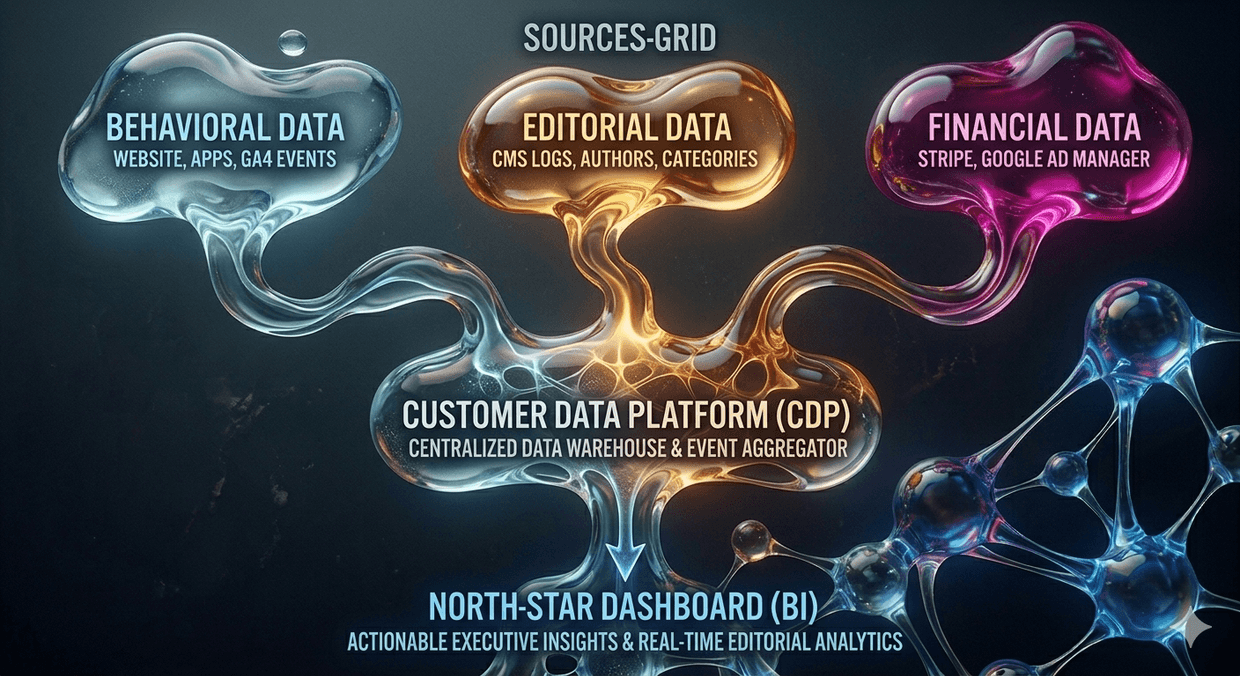
For the implementation of the retention strategy, a technological infrastructure is required that is capable of processing data in real time and ensuring high speed of interaction. In 2026, the foundation of such a process is formed by hybrid CMS integrated with artificial intelligence tools.
Hybrid architecture and performance
Effective formation of habit is impossible without technical stability. Hybrid CMS combine flexibility of content management and high rendering speed, which is critical for Core Web Vitals indicators. Fast page loading not only retains user attention, but also guarantees correct indexing of the resource by search AI bots, preserving the visibility of media in the global network.
AI tools for personalization and segmentation
Artificial intelligence in 2026 has ceased to be an add-on and has become part of the editorial and product process. In the context of community building, AI performs the following tasks:
Dynamic audience segmentation: AI-based algorithms analyze the behavior of Reader ID holders, automatically dividing them into groups by level of loyalty and interests. This allows managers to offer specific interaction scenarios for “newcomers” and “fans”.
Smart recommendation systems: AI assistants inside CMS select relevant content for each user in real time, increasing the recirculation rate (Recirculation Rate) and session depth.
Automation of On-site messaging: AI determines the optimal moment for displaying notifications or offering registration. For example, the system can trigger exactly when reader engagement reaches its peak, which increases conversion into registration.
Predictive analytics: The use of machine learning helps predict the probability of churn (Churn Rate) of loyal readers, allowing timely implementation of retention mechanics and adjustment of the user journey.
Integration of AI into loyalty loops
The use of AI allows making the operation of access systems, such as paywall meter, more flexible. Instead of standard limitations, algorithms can offer individual access conditions depending on visit history and the value of a specific user. Thus, the technological stack of 2026 transforms a static news platform into an adaptive digital product that independently adjusts to the behavioral patterns of each active community member.
Conclusion: From consumption to community
In 2026, the success of a media project is determined by the depth of integration of the product into the daily life of the reader. The transformation of anonymous traffic into a loyal community requires from managers a systematic approach that combines user journey design, implementation of identification tools, and the use of data analytics.
The final goal of this strategy is to create a self-reproducing ecosystem, where the technological stack and editorial content work to retain attention. The implementation of Reader ID, the use of flexible paywall meter systems, and work with habit metrics allow editorial teams to reduce dependence on external algorithms and build a sustainable business model. The application of AI tools inside hybrid CMS provides the necessary level of personalization, turning standard consumption of information into conscious participation of the user in the life of the brand. Thus, the formation of a reading habit becomes the foundation for creating an engaged community of fans, which guarantees viability and competitiveness of media in the long-term perspective.
FAQ: Frequently asked questions
1. What is Reader ID and why is it needed for a news resource?
Reader ID is a unique identifier of a registered user. It allows the editorial team to collect data about reader behavior on the site, personalize content, and build direct communication that does not depend on algorithms of social networks or search systems.
2. How does Paywall Meter work and will it scare away a new audience?
Paywall Meter is a flexible counter of free materials. It does not block access immediately, but allows the user to familiarize themselves with the quality of content. This is a soft engagement tool that offers registration or subscription only after the reader has formed a primary interest in the resource.
3. Which habit metrics are priority?
The most important are Retention Rate (percentage of returning users) and Stickiness Ratio (ratio of DAU to MAU). These indicators more accurately reflect loyalty than total traffic volume, since they capture regularity of product usage.
4. What role does hybrid CMS play in forming loyalty?
Hybrid CMS ensures high rendering speed and stability of site operation (Core Web Vitals indicators). Without technical reliability and fast access to content, it is impossible to retain the user, since any delays lead to growth of bounce rate and decrease in visibility in AI search.
5. How does AI help build a community around media?
AI automates audience segmentation and personalization of recommendations. Artificial intelligence tools analyze Reader ID data and in real time determine which content or message (on-site messaging) to offer to a specific user in order to stimulate their return to the site.
6. What are loyalty loops?
These are repeating cycles of interaction that return the user to the resource. They include external triggers (mailings, push notifications) and internal mechanisms (personalized feed, accumulation of bonuses or reading progress), which gradually turn a random visit into a daily habit.