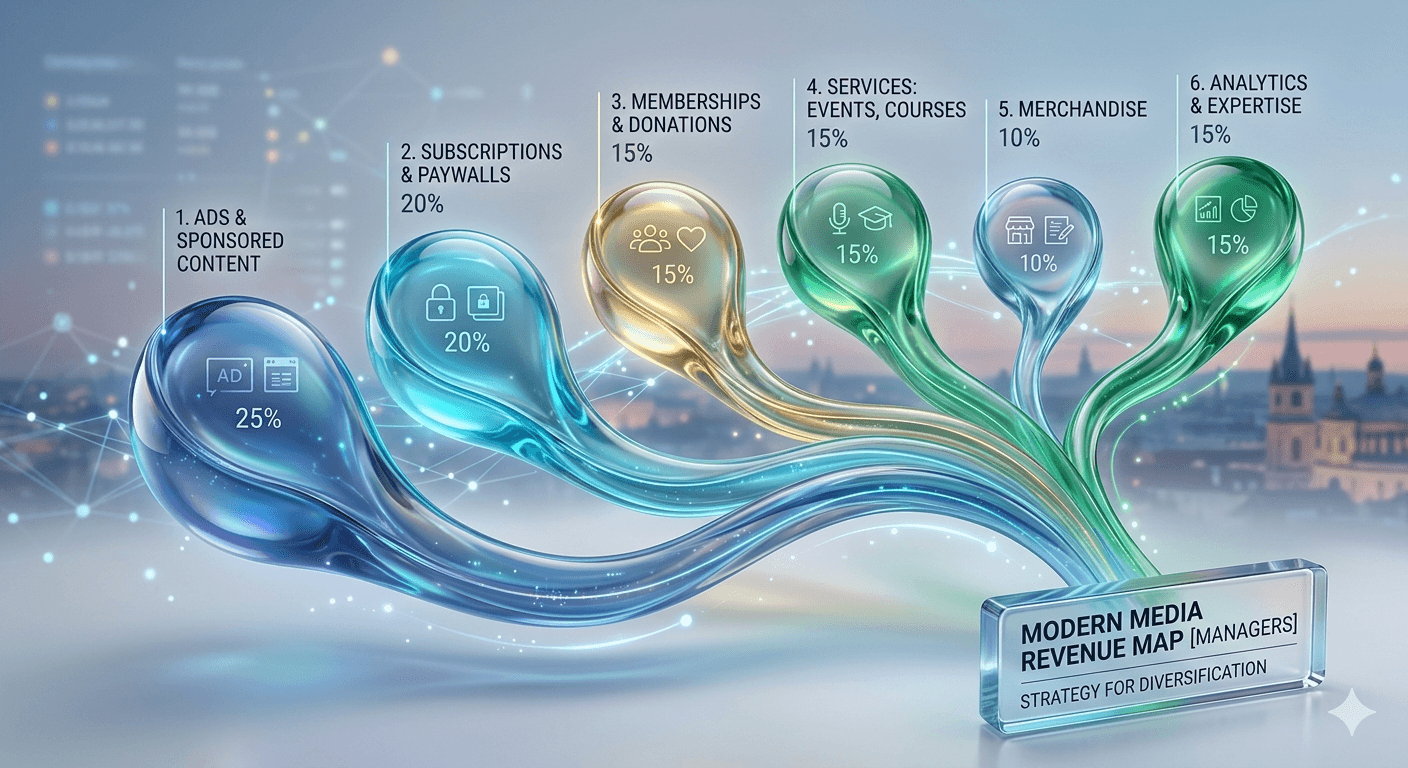
In 2026, the digital media landscape in Europe and on the global market is undergoing a structural transformation: the introduction of artificial intelligence-based answers into search results (AI Search) and the decline of organic traffic from social networks are reducing the effectiveness of the classic advertising monetization model. For local and international content projects, the focus is shifting not to optimizing random clicks, but to building a sustainable Revenue Map based on diversification. In this material, we will examine an applied framework for media managers: how to distribute financial flows between advertising, paid content, community, related services and merch, as well as what technological requirements are placed on the modern CMS architecture for implementing this task.
Transformation of advertising revenue: Effective programmatic and direct sales
Historically, it was the advertising model that remained the main economic engine of the digital press over the past twenty years. The availability of free content distribution systems and the exponential growth of the Internet audience made the banner grid and sponsored integrations the default industry standard. However, today, in 2026, this familiar ecosystem is undergoing a deep technological restructuring, forcing publishers to divide advertising infrastructure into two parallel but fundamentally different directions: automated sales and direct commercial projects.
Automated advertising, or programmatic buying, still performs an important function of monetizing residual traffic that cannot be sold directly. The main task of management in this segment comes down to maximizing the effective cost per thousand impressions with strict control over the technical performance of pages. The main industry standard here remains the combination of Google Ad Manager with Header Bidding technology through open-source solutions, which allows an auction to be launched among dozens of ad exchanges simultaneously on the browser or server side, maintaining a high level of inventory fill rate. At the same time, optimization for Core Web Vitals becomes a critically important factor. An excess of heavy third-party scripts inevitably causes layout shifts and input delays, which worsens the site’s visibility in search and AI systems. Publishers have to implement lazy loading for banners outside the first screen and reserve a fixed height for ad blocks in order to protect user experience and search positions.
In parallel, direct sales are developing, providing media with higher margins and independence from algorithmic fluctuations in the advertising market. In this category, native articles and interactive special projects created by the commercial editorial team for brand tasks come to the fore. Such content must preserve objective usefulness for the reader, so managing it requires flexible internal CMS templates that allow tests or calculators to be quickly assembled without involving frontend developers. Another sustainable format has become long-term sponsorship of niche sections and email newsletters under a fixed-fee model. In the era of the rejection of third-party cookies, advertisers are ready to overpay for direct access to a verified, engaged audience of specific thematic sections.
Decision-making inside a modern advertising department relies on continuous data auditing through analytical platforms such as Google Analytics 4, Parsely or Chartbeat. Management evaluates the effectiveness of the commercial block through a complex of interconnected metrics. In addition to the classic eCPM and fill rate, it is critically important to track the percentage of users blocking advertising — this marker signals in time the excessive aggressiveness of formats. For native materials, the key indicators become not just clicks, but scroll depth and average attention retention time, which objectively confirm the quality of the audience’s contact with the sponsor’s content.
Thus, the advertising model does not disappear from the commercial split of modern media, but its basic elements are undergoing fundamental changes. Aggressive formats and the pursuit of gross view volume are being replaced by strict technical hygiene and the prioritization of user experience. The key success factors become page loading speed, seamless integration of commercial blocks at the CMS level, and the ability to sell the advertiser not random clicks, but directed attention of verified and loyal readers.
Direct audience support: How subscriptions, crowdfunding and membership work
The shift of emphasis from reach advertising indicators to building long-term relationships with the audience has led to the formation of an independent revenue segment based on direct user payments. In the practice of modern media management, this block is divided into two key models: transactional (Subscriptions) and value-oriented (Memberships/Donations). Despite the external similarity — in both cases the reader transfers money to the publication — these approaches rely on different psychological triggers and require different operational tools.
The classic subscription model is built on a commercial exchange: the user pays to receive exclusive content hidden behind a technical barrier (Paywall). The effectiveness of this mechanic directly depends on the editorial value proposition and the flexibility of the settings of the restriction itself. If a Hard Paywall cuts off all non-paying traffic and is suitable mainly for highly specialized B2B publications, then most consumer media tend toward soft or dynamic models. The Metered Paywall option preserves page indexing by search robots, allowing several materials to be read for free, while the dynamic one, based on algorithms, evaluates visit frequency, scroll depth and the user’s device, offering a subscription at the moment of maximum engagement. The product value here lies in the quality of expertise: these can be closed databases, deep industry research, or simply an interface completely cleared of commercial banners.
Unlike subscription, the club model (Membership) and regular donations (Donations) are based not on limiting access to texts, but on the reader’s emotional involvement in the brand’s mission. The user pays for the media to continue to exist and for the right to become part of a professional or thematic community. This format shows high resilience among socio-political, cultural and local city projects. Within the club model, publishers monetize not the text itself, but the related infrastructure: access to closed chats or forums on the site, the opportunity to participate directly in editorial boards, vote for topics of future investigations or attend regular Q&A sessions with authors. For crowdfunding models, transparency becomes a critically important retention element — the editorial team must regularly publish clear financial and content reports, showing patrons exactly which projects the raised funds were spent on.
Managing this block requires regular monitoring of product metrics different from classic advertising eCPM. The manager’s focus shifts to indicators of monthly and annual recurring revenue (MRR and ARR), as well as average revenue per paying user (ARPU). However, the main indicator of the model’s sustainability is the churn rate. If the media attracts new payers but is unable to retain old ones due to a deficit of value or technical failures in card auto-renewal, the subscription economy quickly becomes loss-making. Accordingly, the publication’s technology stack must seamlessly connect the content engine with the CRM system, payment gateways and email marketing tools for automatic management of the user lifecycle.
Subscription economics: How to package and sell content in the era of artificial intelligence
The transition from a reach model to revenue diversification inevitably elevates paid content to the status of one of the main tools for generating predictable revenue. In conditions where generative AI algorithms are capable of instantly duplicating the publicly available news agenda and basic rewrites, the audience’s willingness to pay for access to the site directly depends on the quality of the editorial product and the technological maturity of the platform. A modern subscription is not simply a restriction of access to texts, but a complex product ecosystem requiring flexible management of user experience at the junction of content and IT.
The process of converting a random visitor into a paying subscriber begins with choosing the paywall mechanic (Paywall). The practice of hard closing all materials (Hard Paywall) is gradually becoming a thing of the past, remaining effective only for narrow-niche B2B publications with a high check, where subscription costs are included in companies’ corporate budgets. Most modern media use flexible hybrid schemes. A Metered Paywall leaves open a fixed number of articles per month, which allows preserving the loyalty of search robots and content indexing. The most progressive solution is the Dynamic Paywall. Using machine learning algorithms, the system analyzes user behavior patterns: visit frequency, scroll depth, time of day and device type. Based on this data, the platform automatically determines the propensity to pay and offers a subscription exactly at the moment when the barrier will cause the least irritation and the maximum response.
The defining factor of long-term subscription success remains the formulation of unique value (Value Proposition). The user must clearly understand what added value he pays a regular fee for. Publishers divide this value into content-based and utilitarian. Content-based value includes formats that cannot be reproduced by standard automation methods: deep investigations, exclusive interviews, closed databases, expert industry analytics and forecasts. Utilitarian value closes the need for comfort and saving time. This may be a site interface completely cleared of programmatic advertising and third-party trackers, access to customized author email newsletters, the functionality of audio versions of longreads for listening on the road, or the ability to save materials to a personal archive inside a personal account.
The economy of paid content is fully subordinate to recurring revenue metrics, where the key performance indicators are monthly and annual recurring revenue (MRR and ARR), as well as average revenue per paying user (ARPU). However, the main challenge for the media manager in this model becomes not acquisition, but audience retention — control of the churn rate. High churn quickly neutralizes any successes of marketing campaigns to attract new subscribers. To minimize churn, not only stable text quality is required, but also seamless technical infrastructure. A modern media CMS must be deeply integrated with payment gateways to prevent technical churn (for example, due to card expiration with the help of automatic token update systems) and with a CRM system that allows trigger notifications to be sent in time to users whose activity on the site begins to decline.
Auxiliary services: Monetization of expertise, affiliate marketing and B2B products
In addition to classic advertising tools and collections from readers, the sustainable revenue map of modern media includes a block of auxiliary services. In this model, the content platform acts not simply as a broadcaster of information, but as an authoritative expert center capable of converting audience trust into applied B2B and B2C services. The main directions here are affiliate marketing, organization of specialized events, educational programs, as well as commercialization of the results of complex investigations and analytical expertise.
Affiliate Marketing allows media to earn on recommendations without direct pressure from classic advertisers. Embedding referral links and product widgets into reviews of equipment, software or financial products brings the publication a percentage of subsequent user purchases. The main condition for the long-term effectiveness of this model remains the strict preservation of editorial independence: if the audience notices bias in tests for the sake of maximizing commissions, the value of the brand will be irreversibly lost. From the technical side, this process requires CMS integration with affiliate networks for automatic price updates, click tracking and conversion control.
The logical development of the editorial team’s internal expertise becomes the creation of educational products (courses, intensives and master classes) and the holding of specialized events. Using accumulated knowledge and attracting external speakers, media can launch both mass educational programs for retail users and corporate training for businesses. In turn, event marketing — from chamber closed B2B breakfasts to large-scale industry conferences — allows revenue to be diversified through ticket sales and sponsorship packages to major brands seeking direct contact with the professional community.
A special place in the structure of service revenue is occupied by the commercial capitalization of deep investigations and analytics. Large-scale investigative materials and industry reviews requiring hundreds of hours of work by qualified specialists can be monetized not only through a standard paywall, but also as independent B2B products. On their basis, media forms custom analytical reports for corporate clients, conducts audits of market risks according to individual requests, or carries out content syndication — the sale of rights to publish unique data and infographics to major news agencies and corporations.
The assessment of the effectiveness of the service block is based on specific commercial metrics borrowed from classic e-commerce and consulting. Management tracks customer acquisition cost (CAC), the conversion rate from reader to buyer of a course or ticket, as well as the net margin of each individual direction. An important task at the same time remains the automation of processes through CRM: the system must precisely segment the database, separating from the general mass of readers those who are potentially interested in buying a commercial study or a ticket to a narrow-profile conference.
Physical products: Merch as a tool of branding and capitalization of identity.
Including physical products and merchandising in the revenue map of modern media allows solving two strategic tasks: diversifying financial flows through direct retail trade and materializing the brand, strengthening its presence in the everyday life of the audience. In conditions of digital oversaturation, a physical object becomes an important communication channel. At the same time, the approach to creating merch has undergone changes: the release of standard souvenirs with the media logo applied to cheap blanks no longer brings tangible commercial and marketing results. Modern merch functions according to the laws of independent fashion brands and conceptual design.
An effective diversification strategy through material products is built on the release of thematic limited collections (drops), often created in collaboration with local artists, designers or specialized production facilities. The product line may include both classic clothing and high-quality accessories, as well as specific items directly resonating with the publication’s theme — from printed almanacs and books by the commercial editorial team to specialized tools, stationery or interior items. The main driver of sales here is not the utilitarian need for the item, but the reader’s desire to publicly demonstrate his belonging to the values and intellectual field of a specific media.
An important point of contact inside the overall revenue map is the integration of merch with the club model (Membership). Physical products can act as an exclusive bonus for participants in the higher subscription tiers or be sold to them at a special closed price. This significantly increases the value of membership in the community itself and reduces the churn rate of the paying audience.
From the operational point of view, managing this block is associated with risks non-core for classic media: the need to control supply chains, keep warehouse records, organize logistics and process product returns. In order not to turn the editorial office into a logistics center, management uses hybrid operational models. Work under the Print-on-Demand scheme minimizes storage costs, but limits margin and quality. A more sustainable solution is the transfer of warehouse logistics and delivery to specialized fulfillment operators or the sale of products through integration with large marketplaces, while the online store showcase remains a seamless part of the media’s main site.
The commercial assessment of the effectiveness of the merchandising direction relies on classic e-commerce metrics. The financial department analyzes average order value (AOV), inventory turnover, customer acquisition cost inside the existing reader base and net sales margin after deducting expenses for production, fulfillment and acquiring. The main task of automation at the IT architecture level is to connect buyer profiles in the online store with the general CRM system of the media in order to accurately assess the total lifetime value (LTV) of a reader who purchases both digital and physical products of the brand.
Channel synergy: Building a unified monetization ecosystem.
Dividing the revenue map into isolated directions — advertising, subscriptions, community, services and merch — is justified from the point of view of managerial accounting, but ineffective at the level of operational strategy. The most sustainable media projects function not as a set of disparate commercial tools, but as a unified ecosystem where each element supports and strengthens the others. The main task of management is to design an end-to-end user path in which participation in the community automatically opens access to content, and media formats act as an organic showcase for physical and service products.
The core of such an ecosystem becomes the integration of the club model with paid content and auxiliary services. Instead of selling the reader isolated access to articles, the publication offers a comprehensive participant status (Membership). Within this single package, the user receives not only the removal of technical paywall restrictions, but also priority access to other commercial media products. For example, active community members can be the first and at a reduced cost to book tickets to industry conferences, receive exclusive discounts on the editorial team’s educational courses or download closed analytical B2B reports.
This significantly increases the subjective value of the subscription, turning it from a utilitarian transaction into a long-term investment in one’s own social and professional capital.
In turn, media formats — podcasts, video materials, regular email newsletters and native articles — cease to be exclusively instruments for distributing information and become channels for seamless promotion of internal products.
Advertising one’s own merch, new educational intensives or upcoming club events is not perceived by the audience as aggressive commercial pressure if it is natively embedded in the context of the discussion. Conducting an expert interview in a podcast, the host may refer to a detailed commercial investigation by the editorial team on the same topic, and in a weekly analytical newsletter it is logical to place an announcement of a limited merch drop created jointly with the heroes of past materials.
Such a hybrid approach radically changes the project’s economics, reducing customer acquisition cost (CAC) for each separate direction, since the marketing of services and goods unfolds inside an already loyal, warmed-up reader base. In addition, the user’s diversified activity inside the ecosystem directly reduces the churn rate. If a subscriber temporarily loses interest in regular text materials, he may remain inside the project for the sake of communication in closed chats, attending offline events or using B2B services. As a result, a synergistic effect arises: the media reduces dependence on fluctuations of external platforms by monetizing audience trust at each stage of its interaction with the brand.
Technological foundation: IT architecture for managing hybrid monetization.
The implementation of a hybrid revenue map is impossible without a corresponding restructuring of the publication’s IT infrastructure. An attempt to manage six different revenue streams — from advertising pixels and dynamic paywalls to online store stock balances — using a classic monolithic CMS inevitably leads to technical debt, a drop in page loading speed and data loss. The modern architecture of a media platform must be built according to a modular principle, ensuring seamless integration between the content engine, user management systems and analytical services.
The basis for building such an ecosystem is hybrid or decoupled architectures of content platforms (CMS). The separation of the backend part, where the editorial team creates materials, and the frontend layer responsible for displaying the site allows optimizing page rendering speed, which is critically important for preserving positions in AI search results of search engines and maintaining Core Web Vitals. In addition, the modular structure allows developers to implement commercial widgets, custom Header Bidding advertising scripts or online store blocks through APIs without overloading the main site code with third-party libraries and protecting the interface from uncontrolled layout shifts.
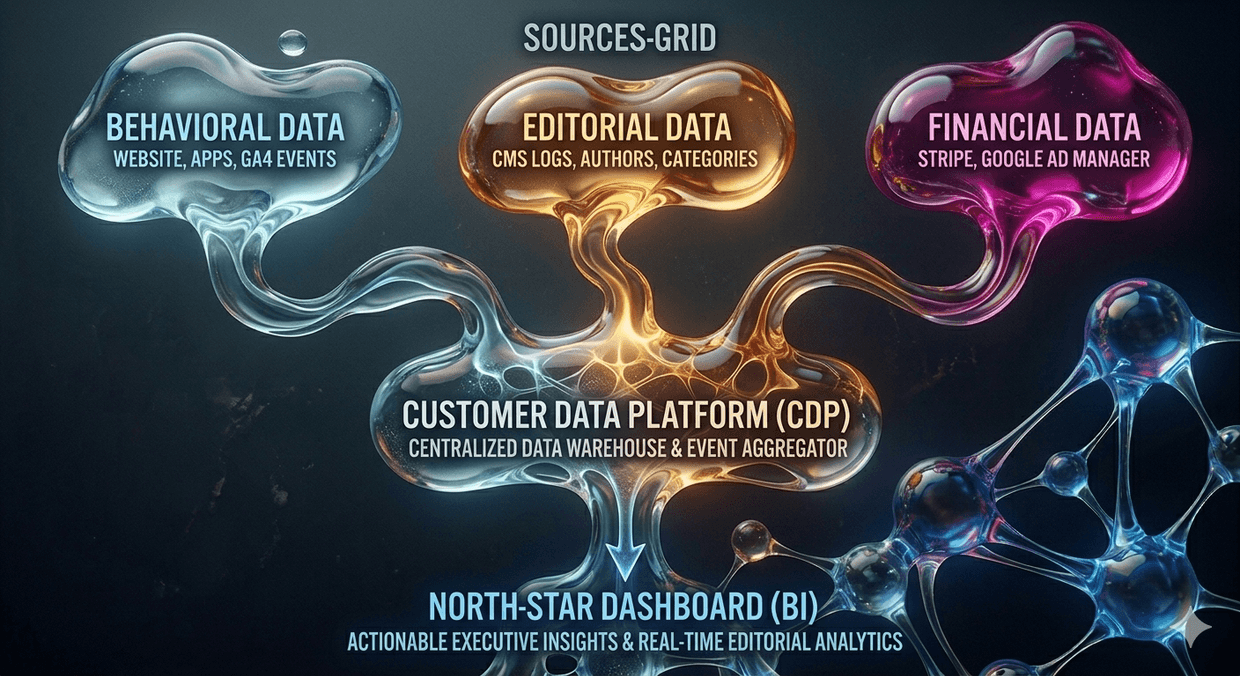
The central node for managing direct revenue (subscriptions, clubs and courses) becomes a customer data platform (CDP or advanced CRM system) integrated with a single user profile (Single Sign-On / SSO). In order for the synergistic model to work, the system must instantly recognize the visitor’s status. When an authorized club member enters the site, the CRM sends a signal to the frontend: disable programmatic banners, open closed analytical articles, pull up a personal discount on conference tickets and display access to the community’s closed chat in the profile header.
The transaction and security layer requires the integration of specialized payment gateways (for example, Stripe, Adyen or local acquirers) with subscription management systems (Subscription Management Platforms, such as Chargebee or Piano). These tools automate recurring payment management, process subscription cancellation scenarios and, most importantly, minimize users’ technical churn. The functionality of automatic card token updates (Account Updater) and flexible algorithms for repeated attempts to charge funds in case of temporary account blocking (Dunning Management) allow up to several percent of the paying base to be retained monthly without involving the support service.
Finally, end-to-end analytics connects technical metrics with financial results. The publication needs a unified analytical circuit combining behavioral data (scroll depth, attention retention time, CTR) with commercial information from the e-commerce block and CRM. Setting up the transfer of First-Party Data — the publication’s own de-anonymized data about audience behavior — allows media management not only to accurately calculate the lifetime value (LTV) of each reader segment, but also to form isolated, targeted cohorts for advertisers, thereby compensating for the industry’s global rejection of third-party cookies.
Conclusion: Deploying the Revenue Map
The transition to a multi-channel monetization model is not a one-time change in commercial policy, but a continuous process of optimizing the media product line. For the successful implementation of a hybrid revenue map, the company’s management must adhere to a systematic approach:
- Technical audit: Bringing the frontend part of the site into compliance with Core Web Vitals requirements, setting up lazy loading of advertising and preparing the modular CMS structure for the integration of future commercial services.
- Implementation of a single profile (SSO): Launching a centralized user authorization system that will allow analytics, CRM and payment gateways to be connected into a common database based on First-Party Data.
- Sequential launch of channels: It is not worth activating all revenue sources simultaneously. The optimal strategy is to stabilize the advertising block, then launch a transactional subscription or club model based on the audience core, and only after that deploy e-commerce (merch) and third-party services (courses, B2B analytics).
- Regular monitoring of Churn Rate and LTV: Shifting the focus from gross traffic volumes to retaining paying users and maximizing their lifecycle inside the brand ecosystem.
Frequently Asked Questions (FAQ)
From what audience volume does it make sense to implement a club model or subscription?
The size of gross traffic (Unique Visitors) is of secondary importance. The determining factor is the volume and density of the audience core — users who return to the site several times a week and spend significant time on it. Practice shows that niche B2B publications can successfully launch a subscription with only a few thousand regular readers, while mass city media need an active community of 10–15 thousand people for a sustainable crowdfunding model.
How will launching a Paywall affect search traffic and the site’s SEO indicators?
When using a Hard Paywall, search traffic will inevitably decrease, since robots will not be able to index hidden content. To avoid this, modern media use dynamic or metered models, as well as Schema.org markup (the isAccessibleForFree properties), which explicitly indicates to search engines which part of the text is hidden from users but should be indexed by the robot. This allows high positions in search and AI results to be preserved.
What margin is considered the norm for the merch direction?
Unlike digital products (subscriptions, courses), where the margin can exceed 80-90%, physical products are burdened with expenses for production, logistics, warehousing and fulfillment. The norm for media merch within a hybrid model is considered to be a net margin of 25–40%. If this indicator is lower, the project becomes economically impractical and should be transferred to the Print-on-Demand model or fully outsourced to partners for the sake of marketing reach.
Will the promotion of own services lead to the outflow of direct advertisers?
No, if the flows are clearly separated. Direct advertisers buy access to your audience in order to promote their own products. The launch of media courses, events or merch covers other user needs and often affects adjacent, but not directly competing markets. Moreover, a developed ecosystem of services and a strong community make the media a more authoritative platform in the eyes of large brands, which allows the cost of direct sponsorship packages and native integrations to be increased.